

Evidence for what?
Why we need to recognise transgender ideation

Clinical clarity. That’s what we’ve needed all along. I read all around me in 2017, when I first started thinking about this issue, but in the absence of a clinical formulation that explained why some individuals were transfixed by the idea of becoming a different person, I was running blind. I didn’t know then what I know now. I didn’t know that there were some clinical formulations back in the 1970s and 1980s. Nor did I know then that there had been a campaign since the 1980s to reformulate transgender ideation as an identity-based issue akin to being gay. (This didn’t happen by accident, by the way – the timeline of the depsychopathologisation movement makes clear that this was a direct consequence of a purposeful campaign.)
In the absence of clinical clarity, I, like thousands of others, scrambled around trying to figure out what was happening. This lack of clarity has had consequences far beyond psychology. Without an agreed descriptive framework, a conceptual vacuum has emerged. Lawyers, politicians, journalists, activists, philosophers, feminists, parents, detransitioners, lesbian and gay rights campaigners and many others have stepped into that vacuum and attempted to explain the same phenomenon using the conceptual tools of their own discipline. They have often worked from different assumptions, different language and different explanatory models because psychology has failed to provide a descriptive framework that commands broad confidence.
That is not to criticise these other disciplines. Lawyers inevitably view the issue through a legal framework, feminists through a feminist framework, politicians through a political framework, and parents through the lens of their own families. Each perspective contributes something valuable. None, however, can substitute for clinical clarity. Psychology has a responsibility to describe conditions rooted in psychological processing so that debates about their causes, implications and appropriate response are grounded in a shared understanding of what is being described. Without a shared understanding, discussion quickly turns into a Tower of Babel.

If there had been an absence of a shared understanding of other psychological conditions that can have a social-contagion component, such as anorexia, bulimia, or self-harming behaviour, clinicians such as me would have been similarly thrown off-course. Thankfully this didn’t happen – for example, the pro-mia and pro-ana sites (particularly rampant in the early 2000s) were universally condemned as written by people with severe mental illness. It is notable, however, that an identity-based, rights-based framework did slip into our thinking about autism and ADHD, and the current mess we’re in now with those two conditions is similar in many ways to aspects of the trans phenomenon.
With the trans phenomenon, we are dealing with profoundly distressed people with healthy bodies who may seek irreversible medical interventions in the hope that their psychological distress will subside. At Genspect, we believe that the common symptom is transgender ideation and that an overvalued belief provides a clinical formulation for understanding how this can occur (more to come on this in the future).
Lisa Littman’s introduction of the term rapid-onset gender dysphoria in August 2018 (note to self: ROGD Awareness Day is this Sunday!) marked an important turning point in attempts to bring greater clinical clarity to the field. The response from trans activists was virulent, and subsequent efforts to pursue this line of clinical inquiry were quickly silenced.
By 2019, GIDS had already lost 35 clinicians over three years while Dr David Bell had produced a damning internal report and Marcus Evans had resigned as a Tavistock governor after concluding that the concerns being raised had not been properly addressed. Hannah Barnes documented the problems at GIDS in her 2023 book Time to Think, and the Cass Review highlighted the startling lack of an evidence base to support these radical interventions. GIDS was eventually closed down.
It is now clear that GIDS clinicians were flailing for two main reasons – there was an unprecedented explosion in the numbers of adolescents seeking medical transition and an identity-based, rights-based formulation had replaced earlier clinical formulations proposed by the likes of Dr Paul McHugh in previous decades.
In Britain, we’ve had the Forstater judgment affirming the protection of gender-critical beliefs, the Keira Bell judicial review, the Cass Review, the closure of GIDS, and the Supreme Court’s ruling in For Women Scotland that the words “woman”, “man” and “sex” in the Equality Act 2010 refer to biological sex. Nevertheless, the new gender hubs that have emerged since the closure of GIDS have been reported by Genspect parents as being almost as bad as GIDS at its nadir. These identity-based centres act as people who identify as transgender are members of a sacred caste who require immediate medicalisation which is not currently on offer through the NHS. The clinicians working there are mostly ideological – the few that aren’t have no integrity as they are part of a system that is knowingly causing harm to extremely vulnerable minors.
The absence of a psychologically based clinical formulation is perhaps most starkly illustrated by Dr Hilary Cass becoming one of the principal advocates for the proposed NHS puberty blocker trial, despite the absence of reliable evidence that these drugs are safe or clinically effective, and without a clear account of either the condition being treated or the outcome treatment is supposed to achieve. The depth of the conceptual confusion was reflected in the House of Lords, where Cass recently described the case of a child who was socially transitioned by his parents at the age of two and who, by the age of eleven, was bedroom-bound, no longer attending school and suffering from weak bones.
WPATH itself, as always, provides perhaps the clearest illustration of the problem. In a July 2026 federal court filing, WPATH has now conceded that its Standards of Care are, legally speaking, merely expressions of opinion about what the existing scientific evidence supports. It also relied upon the Supreme Court’s acknowledgement of “medical and scientific uncertainty” in this field and argued that individual doctors bear independent responsibility for the advice they give their patients. This is quite some distance from the certainty with which gender-affirming medicine has often been presented.
But it also brings us straight back to the problem of clinical clarity. If clinicians bear independent responsibility for determining what is appropriate for each patient, what exactly are they assessing? What psychological process are they trying to understand?
Genspect proposes transgender ideation rooted in an overvalued belief. Others, including Cass and many gender-critical organisations, propose what I call tiny numbers theory; that a small number of people have a trans identity that requires medicalisation, and that sufficiently rigorous safeguarding can identify those for whom these interventions are appropriate. Many gender-critical organisations therefore oppose irreversible medical interventions for under-18s, yet accept that once a person turns eighteen, they are free to pursue medical transition, even when their thinking may be profoundly affected by severe mental illness.
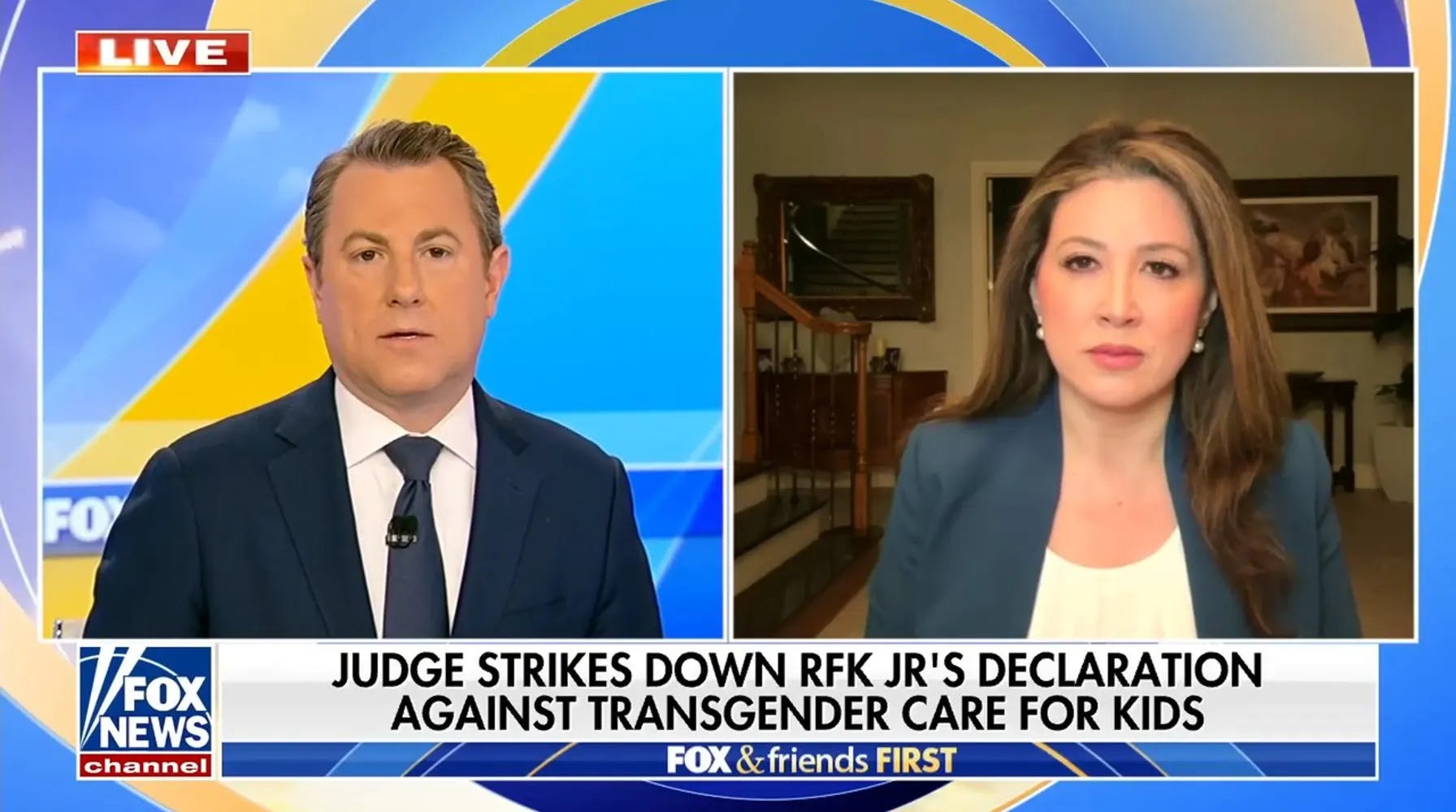
The situation in the United States illustrates where this conceptual confusion can lead. The Trump administration has now moved to end Medicaid funding for medical transition procedures for minors, another significant reversal after years in which an identity-based model became embedded within American medicine.
Many people who have campaigned against the medicalisation of children will celebrate this. As do I. But I also worry about where the debate is heading.
In America, the political right has now seized upon “gender identity medicine” as a right-wing talking point. This issue looks set to become another permanent weapon in America’s eternal red-versus-blue culture war, endlessly fought over in much the same way as abortion and gun laws. We could go around this merry-go-round for decades.
There is another problem too. For years, critics of gender identity medicine have concentrated overwhelmingly on children. The message has often been that this should not happen, and especially not to children. But the public heard a different message that this is basically fine, but certainly shouldn’t be allowed for children.
Our messaging has been wrong. Of course children require particular protection. But turning eighteen cannot transform an inappropriate medical intervention into an appropriate one. Nor does a person’s eighteenth birthday tell us anything about the psychological process that led them to seek medical transition in the first place.
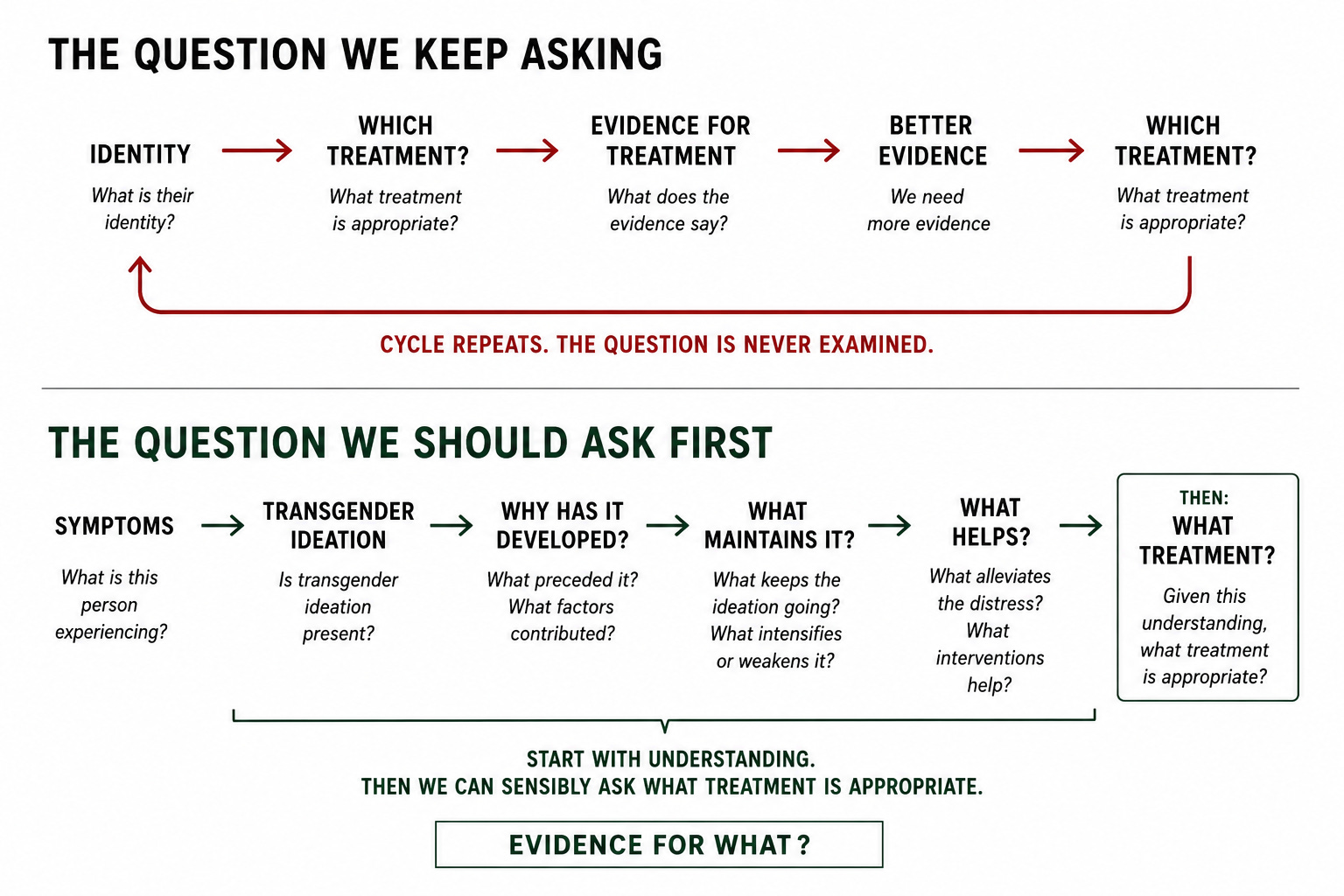
The question we should have been asking all along is not simply, “How old is this person?” or, good grief, “What is their identity?” It is “What are we treating?”
The better starting point is transgender ideation itself. When did it emerge, and what preceded it? What problem does the person believe transition will solve? How strongly is that belief held, and how open is it to alternative explanations? What intensifies or weakens the ideation? What psychological and social factors sustain it? And, perhaps most importantly, what would it mean to the person if transition were not the answer?
That is why clinical clarity matters so much. Identity-based medicine is inherently flawed. Rights-based medicine is another term for consumer-driven medicine. What we actually need is evidence-based medicine. But simply calling for better evidence is not enough. Evidence for what?
There is a deeper problem. Some questions cannot be settled by accumulating more evidence. Evidence can tell us what an intervention does; it cannot, by itself, tell us whether medicine ought to do it. Are there limits to what clinicians should help a person do to a healthy body in an attempt to resolve psychological distress? That is not simply an empirical question. It is a question about the proper limits of medicine itself. Unless we confront it directly, we risk conducting ever more research within a therapeutic model whose underlying premise has never been adequately examined.
That does not make evidence irrelevant; it makes the choice of what we investigate all the more important. The first task is to understand what is actually being treated. We need evidence about what causes transgender ideation to emerge and persist, what alleviates the distress associated with it, and which psychological interventions help people. Only then can treatment research be properly framed. Where the evidence is uncertain, clinicians should proceed cautiously, beginning with a careful analysis of the presenting symptoms alongside a least-invasive-first approach.
Whatever explanation one favours for that child’s distress, we are plainly looking at a profound psychological process. One thing is sure though, the current confusion and obfuscation cannot continue. We are well past the time for vague language; clinical clarity is imperative.
Thank you for explaining things so clearly and reassuring us that our minds are still working okay!”
All the best to you !
Psychological clarity that grounds the therapeutic process.
Your framing answers the questions: Where do we begin? How do we engage in and maintain sound, psychological, therapeutic work in the therapy room?
Absolutely necessary and endlessly helpful.